No Stream, No Trace: The Underground Record Culture That Big Tech Can't Touch
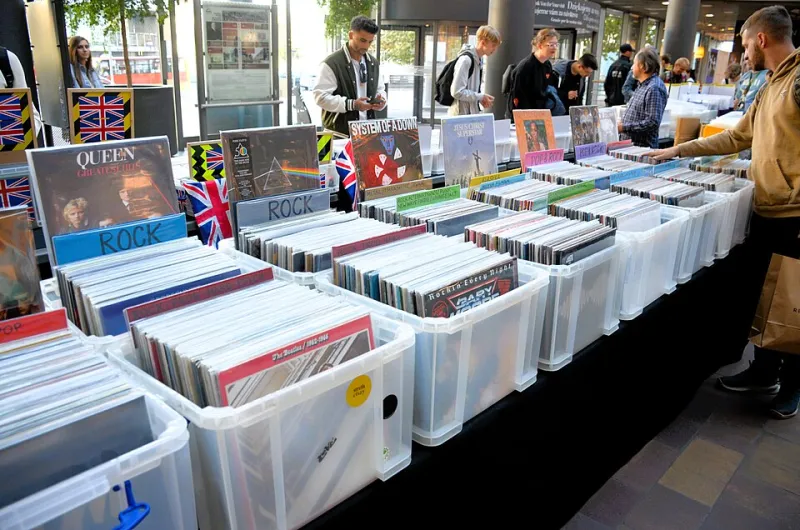
Photo: Silar, CC BY-SA 4.0, via Wikimedia Commons
Here's something the algorithm cannot do: it cannot see what's playing on a turntable in a basement in Bushwick at 11 p.m. on a Tuesday. It cannot log the cassette someone dubbed from a record they found at a Goodwill in Albuquerque and mailed to a stranger they met on a forum. It cannot analyze, categorize, recommend, or monetize any of it. That's not a bug in the system these kids have built. That's the entire point.
The Rejection Is Architectural
Let's be clear about something: the vinyl revival isn't new, and think pieces about Gen Z buying records have been running since roughly 2019. But what's happening in the more committed corners of physical media culture right now is different from the general trend of young people buying Taylor Swift on wax at Target. That's consumption. What we're talking about is infrastructure.
There are trading networks — some operating through Discord servers you need a referral to join, some through old-school forum threads, some through literal handwritten lists circulated at shows — where people swap physical media according to rules that have nothing to do with commercial value. The currency isn't money and it isn't clout in any measurable sense. It's taste, demonstrated through what you bring to the table. Literally.
One network operating out of the mid-Atlantic region runs what they call a "tape tree" — a format borrowed from the 1970s Grateful Dead bootleg community, updated for the current moment. Someone seeds the tree with a dubbed cassette of something they consider essential and underheard. That person sends copies to three people. Each of those people adds something and passes it forward. The recordings that make it furthest through the network are, by definition, the ones that resonated most with the most people. No algorithm. No play count. No metric except whether someone cared enough to keep it moving.
Why Physical Media Became a Status Symbol
Spend any time in these communities and you'll hear a phrase that comes up constantly: "unmeasurable taste." The idea is straightforward. Everything you do on a streaming platform is logged, analyzed, and fed back into a system designed to keep you engaged and predictable. Your listening history is a product. Your taste, as far as Spotify is concerned, is a dataset.
Owning a record or a cassette breaks that loop entirely. There is no playback data. There is no engagement metric. The music exists in a physical object that sits on a shelf or in a box, and the only person who knows you own it is you — and whoever you decide to tell. In a media environment where everything is tracked and everything is content, that invisibility has become genuinely aspirational.
This is especially sharp among the more politically minded corners of these communities, where the conversation about physical media connects explicitly to broader anxieties about surveillance, data ownership, and the homogenizing effect of recommendation engines. When the algorithm decides what you hear next, you're not discovering music — you're being served music that a platform has determined is statistically likely to keep you subscribed. The physical media crowd finds that insulting, and they're not quiet about it.
The Listening Club Circuit
Across the country, a loose network of listening clubs has been quietly expanding — gatherings where people bring records or tapes, play them for each other, and talk about what they're hearing without any of it being documented for external consumption. No livestreams. No setlists posted afterward. Sometimes no phones at all, depending on the host.
These aren't the kind of events you find on Eventbrite. They spread through word of mouth, through trusted contacts, through the kind of social infrastructure that predates the internet and has survived it. A club in Chicago that started as four friends in an apartment now rotates between a dozen different homes and has a waitlist. A similar setup in Los Angeles started specifically as a cassette-only space and has stayed that way.
The format varies. Some are structured around a theme — one person brings everything they own from a specific year, or a specific city's scene, or a specific pressing plant. Some are pure free association, with the host just pulling things off the shelf and seeing where the night goes. What they share is the insistence on presence. You have to be in the room. You have to listen. You cannot skip.
The Curation Is the Point
Here's the thing that gets lost in the broader "vinyl is back" conversation: for the people in these communities, the physical object is only part of the value. The deeper value is the curation practice that owning physical media forces on you.
When your music collection is digital and unlimited, the question of what to listen to becomes almost paralyzing. The algorithm steps in to solve that problem, and in solving it, it takes over. When your collection is physical and finite, every addition is a decision. You have limited shelf space. You have limited money. You have to actually know what you want and go find it, which means you have to develop a real point of view.
That practice — of developing taste through scarcity and intention rather than abundance and recommendation — is what the most serious collectors talk about when they explain why this matters to them. It's not about the warm sound of vinyl or the lo-fi charm of cassettes, though those things are real. It's about what the constraint of physical media does to you as a listener. It makes you accountable to your own taste in a way that streaming never will.
Off the Grid, On the Frequency
This is the kind of culture XHXH Signal was built to document — the stuff happening in rooms and networks and trading circles that the mainstream music press doesn't cover because there's nothing to embed, no stream to link to, no analytics to cite. It's alive precisely because it's invisible.
The algorithm will keep optimizing. The platforms will keep logging. And in basements and living rooms and community spaces across the country, someone will be dropping a needle on a record that doesn't exist in any database, in a room full of people who aren't broadcasting it anywhere, building a culture that the machine genuinely cannot see.
Tune in if you know the frequency.